Abstract: In the age of social media, the central challenge of marketing has shifted from recall to replication. Memes have become the dominant cultural currency of the digital era, while celebrities increasingly function as continuous generators of shareable cultural moments. But where do brands fit into this ecosystem? Can brands themselves become celebrities? And does a large follower base necessarily translate into true influence or virality? This column explores the evolving relationship between memes, celebrity and brands, arguing that the future lies not in chasing random virality but in what might be called “brandcasting” — the transformation of brands into sustained cultural presences that entertain, inform and emotionally engage audiences. Drawing on global and Indian examples including Amul, Zomato, Swiggy and Cred, the article examines how brands can move beyond advertising to create enduring cultural meaning.
Once upon a time, the marketer’s central challenge was to get consumers to remember a brand. Today, in the age of social media, the challenge is getting consumers to share it. That seemingly small shift marks one of the most profound transformations in the history of marketing communications. The dominant cultural unit of the digital era is no longer merely the advertisement or even the story. It is the meme.
The meme, as biologist Richard Dawkins originally conceived it, is a unit of cultural transmission — an idea, image, phrase or behaviour that replicates itself from mind to mind. Social media has industrialised this process. Today, memes spread at the speed of electricity through billions of connected devices and human nervous systems. In the process, virality has become the holy grail of modern communications.
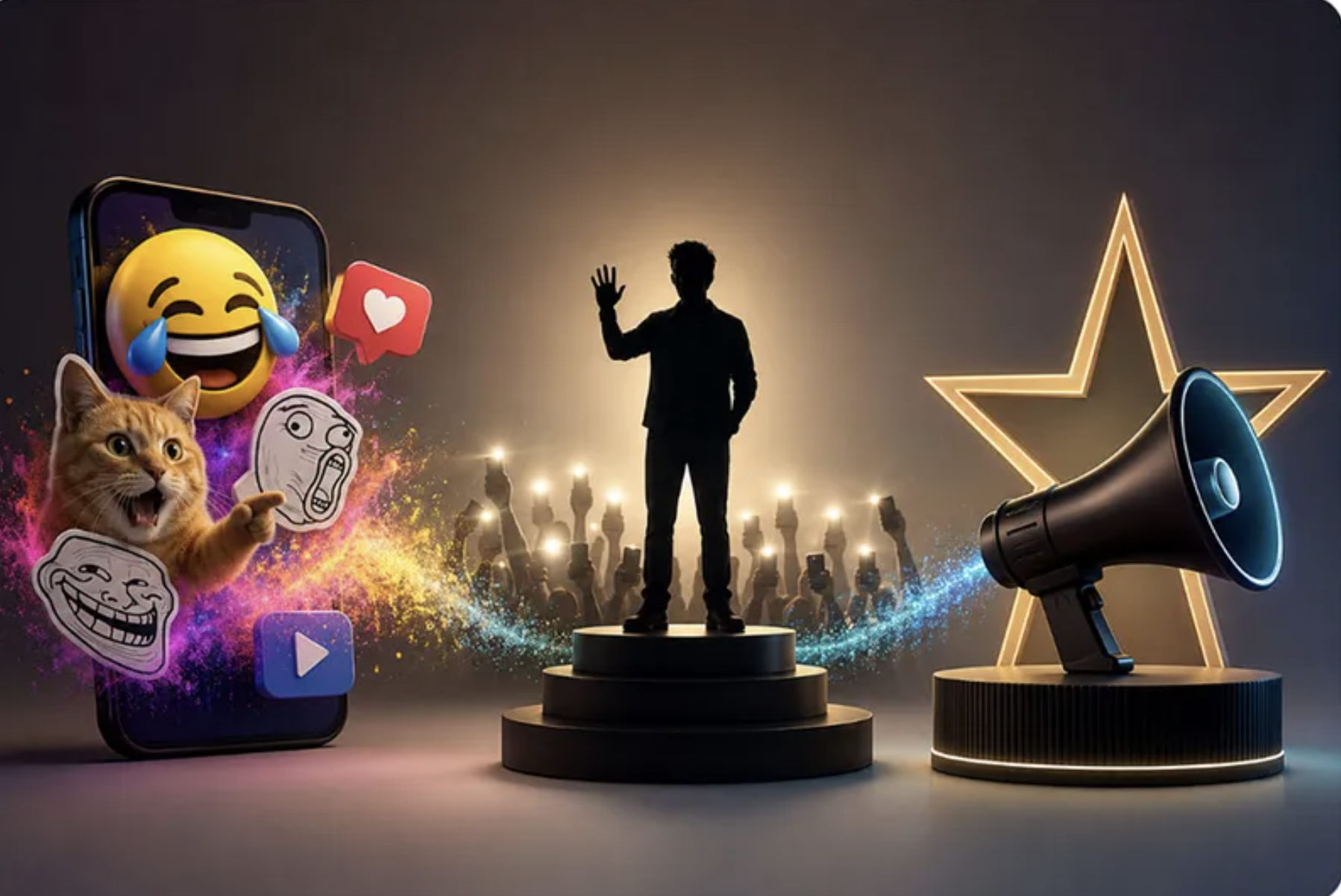
But virality is frequently misunderstood. Marketers often treat it as though it were simply a larger form of reach. It is not. Reach merely means people saw something. Virality means they felt compelled to pass it on. Advertising sought recall. Social media seeks replication. And this shift has transformed not only marketing, but celebrity itself.
In the pre-digital era, celebrity was a relatively stable condition bestowed by institutions — film studios, television networks, sports leagues, publishers and mass media. Celebrities occupied pedestals and audiences gazed upward. Social media demolished the pedestal and replaced it with a feed. Today, celebrity is increasingly the condition in which an individual becomes an assumed frequent generator of memes. Celebrities possess large audiences not merely because people admire them, but because audiences expect a continuous stream of culturally shareable content — jokes, opinions, outrage, glamour, confessions, reactions, dances, controversies and fragments of life. The modern celebrity is, in effect, a human meme engine.
This expectation of perpetual cultural emission explains why digital celebrities post incessantly, why silence is dangerous, why algorithms reward frequency and why influencer burnout has become so common. Influencer marketing emerges naturally from this environment. Brands seek to attach themselves to individuals who appear capable of repeatedly generating cultural attention. Yet even here, marketers often confuse followers with influence.
A person may have 20 million followers and still produce content that barely travels beyond their immediate audience. Most social media content, even from major celebrities, is consumed passively and forgotten instantly. Only a tiny fraction escapes the gravity of the feed and enters broader cultural circulation. The same problem confronts brands.
Can a product or service brand become a celebrity in its own right? At first glance, the answer appears obvious. Many brands have amassed enormous social media audiences. Nike, Red Bull, Netflix, Coca-Cola and Apple command audiences larger than those of many nations. Some Indian brands too have become powerful social-native entities in their own right. But do followers automatically make brands celebrities? Not necessarily.
The interesting thing about brands that sustain large digital followings is that they are rarely behaving like conventional advertisers. Instead, they increasingly behave like broadcasters, entertainers and cultural participants. This is where I would like to introduce the term “brandcasting”.
Brandcasting is successful and ongoing content marketing elevated into a sustained cultural presence. It is the process by which brands evolve from intermittent advertisers into continuous producers of entertainment, participation, information, emotion and identity. In effect, the brand begins to behave like a media organism.
The most successful examples already understand this intuitively. Red Bull is not merely selling an energy drink. It has built an entire media ecosystem around extreme human performance, adventure and risk. Netflix functions less like a streaming service and more like a perpetual cultural conversation machine. Nike continuously manufactures emotionally charged narratives around aspiration, resilience and self-transformation.
India too is beginning to witness early forms of sophisticated brandcasting. Amul may actually have been India’s original meme engine decades before social media existed. Its topical hoardings anticipated meme culture by rapidly responding to politics, cinema, sport and public events with humour and visual wit while maintaining remarkable consistency of tone and identity. Zomato and Swiggy have evolved into social-native entertainment brands. Their feeds often participate in everyday Indian humour, cricket fever, workplace anxieties and urban relationship culture with a fluency that frequently transcends the transactional category of food delivery.
Cred has attempted something even more interesting. Instead of narrowly advertising credit card bill payments, it has invested in absurdist humour, celebrity subversion and internet-native storytelling. Many of its campaigns are designed less as direct-response advertising and more as culturally discussable artefacts. Similarly, beauty and fashion platforms such as Nykaa increasingly operate as hybrid commerce-media ecosystems built around tutorials, influencers, beauty education and aspirational participation
In each case, the brand is transcending its functional category and entering the realm of culture. This distinction is critical. A detergent brand endlessly posting product shots is unlikely to become a cultural force. But a brand that consistently creates emotionally resonant, entertaining or participative experiences may gradually acquire celebrity-like characteristics.
Yet the relationship between brands and memes remains fraught with danger. Particularly dangerous is the “unofficial” meme — where third parties create viral content involving a brand without the brand’s creative control. Marketers often celebrate any visibility as good visibility. But memes are chaotic cultural organisms. They simplify, exaggerate and distort. They frequently reduce brands into caricatures detached from the strategic meaning painstakingly built over decades. A customer service fiasco, an awkward advertisement, a strange visual or an ill-judged tweet can suddenly become meme fodder. Once released into the digital bloodstream, the brand loses control over interpretation.
Cultural visibility is not automatically cultural equity. In fact, uncontrolled memeification is often corrosive because memes thrive on exaggeration while brands require coherence, continuity and trust.
This is why brandcasting matters strategically. The best forms of brandcasting go beyond merely generating attention. They create what might be called cultural utility — experiences, humour, education, stories or participation that audiences value independently of the product itself while remaining emotionally aligned with the brand. In other words, the content must have standalone value even if the product disappears from the frame.
This marks a profound shift in the nature of branding itself. For nearly a century, brands largely interrupted culture through advertising. Increasingly, however, successful brands seek to inhabit culture continuously. The modern brand is slowly evolving from advertiser to broadcaster, entertainer, educator and community host.
But brands should not confuse themselves with memes. Memes are thermodynamically unstable cultural objects. They flash brightly and vanish. Celebrity is somewhat more durable because it creates an expectation of repeated meme production. Brands, however, operate on a far longer time horizon. Brands are repositories of accumulated trust, memory and emotional meaning. Which is why the goal of brandcasting is not endless virality. The goal is sustained cultural relevance.
Memes generate attention. Celebrities sustain attention. But brands, at their best, convert attention into enduring meaning.
Suggested Reading List
- The Selfish Gene — Especially the original conception of the “meme” as a unit of cultural transmission.
- Understanding Media by Marshall McLuhan — Foundational for understanding how media environments reshape culture and behaviour.
- Amusing Ourselves to Death by Neil Postman — On entertainment, media and public discourse.
- Contagious: Why Things Catch On by Jonah Berger — A practical exploration of why certain ideas and content spread.
- The Attention Merchants by Tim Wu — On the economics of attention in media and advertising.
- The Medium is the Massage by Marshall McLuhan and Quentin Fiore — Still startlingly relevant in understanding social-media-age communications.
- No Logo by Naomi Klein — A seminal critique of brands as cultural forces.
- Purple Cow by Seth Godin — On remarkability and attention in crowded markets.

 hardraincafe.blog