Abstract: As AI increasingly enters the world of creative production, society finds itself confronting a question long familiar in athletics: what constitutes legitimate enhancement, and what crosses into unacceptable intervention? This column explores the historical tolerance of “performance enhancement” in the arts — from narcotics to digital tools — and examines how AI is reshaping our understanding of creativity, authorship and authenticity. It argues that while transparency around AI collaboration is important in the early years, the future may reverse today’s assumptions: AI-assisted creativity will become normal, while purely human-made work may emerge as a rare artisanal category
Every age invents its own shortcuts to transcendence. The athlete swallows a pill. The poet drinks absinthe.
The guitarist lights a joint. The coder opens ChatGPT.
And society, curiously, reacts very differently to each.
In sport, the matter appears settled. Performance-enhancing drugs are cheating. The reason is obvious enough. Athletics and sport are fundamentally comparative activities. One human being or team is measured directly against another. A hundredth of a second matters. A single extra kilogram lifted matters. The intervention, therefore, corrupts the fairness of the contest. Which is why every Olympics eventually produces its ritual sacrifice: a disgraced sprinter, a fallen cyclist, a swimmer stripped of medals, a nation accused of systematic doping. We continue to be shocked because sport still rests on an old romantic ideal – that what we are witnessing is the naked excellence of the human body and spirit.
Creative activity is different. The novelist is not racing another novelist across a finish line. A sitar maestro is not disqualified because another musician composed a more moving raga. Even in collective arts like cinema, theatre, orchestras or advertising, the essential struggle remains inward. The artist wrestles principally with herself – with doubt, imagination, memory, craft, discipline and the terrifying possibility of failure.
Because creativity is not directly comparative, society has never quite managed to create a universally accepted moral code around “performance enhancement” in the arts. And enhancement there has always been. History is practically soaked in it.
Writers and poets have leaned on alcohol, opium, amphetamines and psychedelics. Jazz culture was inseparable from narcotics for long stretches. Silicon Valley’s mythology includes everything from LSD to micro-dosing. Countless musicians, painters and screenwriters have depended on chemical interventions to sustain productivity, confidence, emotional intensity or altered perception.
Society frowned, certainly. Families worried. Careers collapsed. But there was never a globally institutionalised anti-doping authority for painters or playwrights. No equivalent of WADA exists for the arts.The assumption, perhaps, was this: if the work moved you, the work stood on its own.
Now arrives AI – the newest and perhaps most profound performance-enhancing intervention of all. And suddenly, the old ambiguity around creative enhancement has exploded into public consciousness.
The anxiety is understandable. We are already drowning in AI-generated slop: synthetic articles, fake images, imitation voices, manufactured outrage, automated spam masquerading as insight. The internet increasingly resembles a city where half the inhabitants are ghosts pretending to be human. Naturally, creators, publishers and audiences are alarmed.
But beneath the noise lies a more nuanced and difficult question. What exactly constitutes “AI-created” work? Recently, a short story that won acclaim became the subject of controversy when someone claimed – based on stylistic analysis and AI-detection tools – that it had been “created by AI.”
That phrase is spectacularly ambiguous. Did the AI generate the story entirely on its own? Did the human merely type a prompt? Or did a writer labour intensely over structure, voice, rhythm, edits and emotional texture while using AI as a collaborator, editor, sounding board or idea amplifier?
Those are not remotely the same thing. To collapse all AI-assisted creativity into one category is intellectually lazy. A filmmaker using CGI is not equivalent to a machine generating an entire movie. A photographer using Photoshop is not the same as an algorithm creating synthetic humans. A composer using digital tools is still composing.
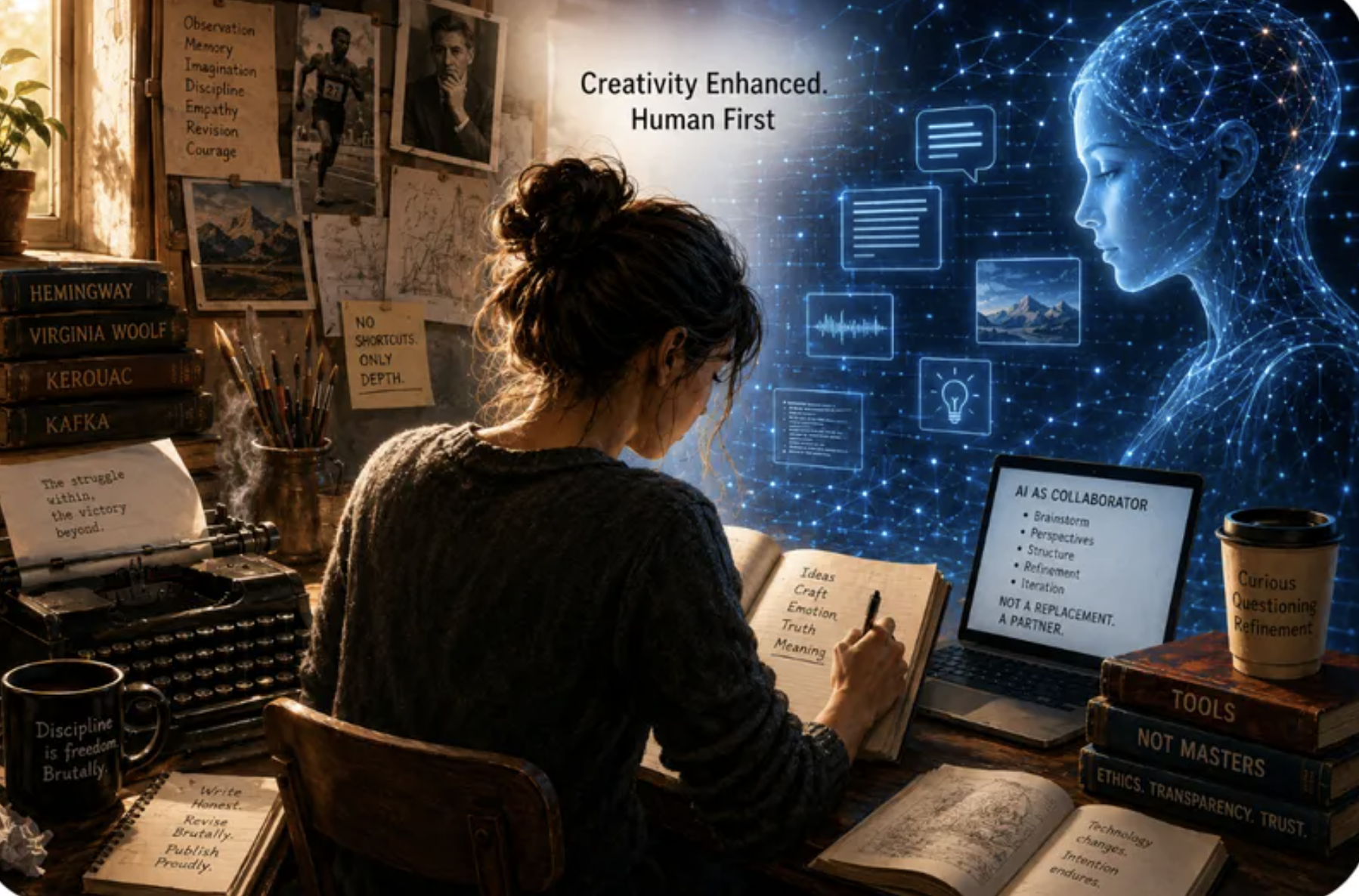
The relationship between creator and tool matters. And we are entering an era where that relationship will become increasingly fluid. Already, millions of people use AI not as a replacement for creativity but as an augmentation of it. Designers brainstorm with it. Writers bounce ideas off it. Advertisers use it to accelerate iterations. Musicians explore variations through it. Architects visualise possibilities through prompts.
In advertising and marketing – where speed, iteration and collaborative ideation are central — this shift is already effectively normalised. Nobody in a modern agency asks whether software assisted the work. The only real question is whether the output works.
Yet we remain culturally unsettled because AI feels different from previous tools. It appears less like a hammer and more like an eerie cognitive companion. It generates language, images and concepts with unnerving fluency. It seems to trespass into domains we considered uniquely human. Which is why disclosure matters – at least for now.
In these early years of AI-assisted creativity, creators who make significant use of AI would be wise to acknowledge that partnership up front. Publishers and distributors should also develop norms of transparency. Consumers deserve to know whether a work emerged entirely from human effort or from some form of human-machine collaboration.
Not because AI-assisted work is inherently inferior. But because audiences are still culturally calibrating themselves to this new reality. Transparency builds trust.
It also enables a richer understanding of creativity itself. We may discover that the most interesting works are neither purely human nor purely machine-generated, but strange hybrids — products of dialogue, tension and co-creation between biological and synthetic intelligence.
Over time, however, the emotional temperature around this issue will cool. History suggests it always does.
There was a time when photography was considered a threat to painting. Synthesisers were accused of corrupting music. Digital editing was considered suspect. CGI was dismissed as fake cinema. Today these debates feel quaint. The tools disappeared into the background while attention returned to what ultimately matters: the quality of the experience.
AI will likely follow the same trajectory.
Within a decade or two, using AI in creative work may become as commonplace – and as unremarkable – as using spellcheck, editing software or visual effects. Creative collaboration with AI will simply become part of the grammar of modern production.
And then a curious reversal may occur. The works that will stand apart will not be AI-assisted creations. Those will be normal. Instead, special significance may attach itself to works certified as entirely human-made.
“Written without AI assistance.”
“Composed entirely by human musicians.”
“No synthetic imagery used.”
In a world saturated with machine collaboration, purely human creation may acquire the aura of handcrafted luxury. Rather like artisanal craft today. Nobody needs to label a factory-made chair. That is the default assumption. But a hand-carved chair made by a master craftsman commands attention precisely because it resists industrial intervention.
The same may happen to art. And perhaps that is fitting. Because technology rarely destroys human aspiration. More often, it changes what humans value.
When calculators became universal, mental arithmetic became a specialised skill. When photography democratised portraiture, painting evolved toward impressionism and abstraction. When machines mastered repetitive labour, handmade goods became markers of authenticity and prestige.
AI may not end creativity. It may instead force us to redefine what we mean by human creativity in the first place. The athlete seeks victory over others. The artist, ultimately, seeks victory over silence. And humanity has always used tools in that struggle.
PS: In the spirit of full disclosure, this article is a collaborative effort between ChatGPT and me. If asked to quantify, I would say it is 70% me and 30% ChatGPT. I asked ChatGPT for the ratio, and its ever-polite response was 90% me, 10% it!
Suggested Reading
Marshall McLuhan — Understanding Media: The Extensions of Man
Walter Benjamin — The Work of Art in the Age of Mechanical Reproduction
Nicholas Carr — The Glass Cage: Automation and Us
Jaron Lanier — You Are Not a Gadget
Ted Chiang — “ChatGPT Is a Blurry JPEG of the Web” (The New Yorker)
Brian Eno — writings and interviews on generative art and creativity
David Epstein — The Sports Gene
Richard Sennett — The Craftsman
Yuval Noah Harari — Homo Deus
Articles and debates around AI-generated fiction in Clarkesworld, The Atlantic, and MIT Technology Review


