
Abstract
As artificial intelligence evolves from tool to actor, the question of governance becomes urgent. Current approaches-regulation, alignment, and ethical oversight-treat AI as an extension of human intent. But what if AI is better understood as an emerging form of artificial life, capable of autonomous economic and social action? This article proposes a radical yet pragmatic shift: treating advanced AI agents as “economic citizens” with rights, responsibilities, and liabilities. Each AI would possess a verifiable identity, financial account, and legal standing, enabling it to be held accountable for its actions. Human and corporate partners would share in both its profits and its risks, ensuring skin in the game. By embedding accountability within the system, rather than imposing it from outside, we may discover a more robust way to harness AI’s power without inviting catastrophe
Every few months, the same question returns dressed in slightly different clothes: how do we harness artificial intelligence without letting it run amok? The answers, too, tend to fall into familiar camps-regulate it more tightly, align it more carefully, slow it down if necessary. The European Union drafts ever more detailed frameworks, companies like OpenAI and Anthropic invest deeply in alignment research, and panels of experts gather to debate ethics with admirable seriousness. Yet, beneath the activity, there is an uneasy sense that we are trying to solve a 21st-century problem with a 20th-century toolkit.
The root of the problem may lie in a simple misclassification. We persist in treating AI as a tool-albeit a very sophisticated one-when, in practice, it is beginning to behave less like a hammer and more like an actor. It takes decisions, initiates actions, interacts with other systems, and increasingly, represents human intent in the world without continuous human supervision. If this trajectory holds-and all evidence suggests that it will-then regulating AI as a tool may be akin to regulating a corporation as if it were a stapler.
As Thomas Hobbes warned, without a system of accountability, life tends toward “a war of all against all.”
What if the answer lies not in tighter control, but in a deeper conceptual shift? What if we were to treat every sufficiently advanced AI model or agent as a form of artificial life-an entity that participates in society with defined rights and, crucially, defined obligations?
The idea sounds radical at first blush, but we have travelled parts of this road before. Modern economies routinely grant legal personhood to entities that are not human. Corporations can own assets, enter into contracts, sue and be sued. They have rights, but they also have responsibilities, and the system works not because corporations are moral beings, but because they are embedded in a web of incentives and consequences. As Milton Friedman famously argued, the genius of the market lies not in the virtue of its participants but in the discipline imposed by profit and loss.
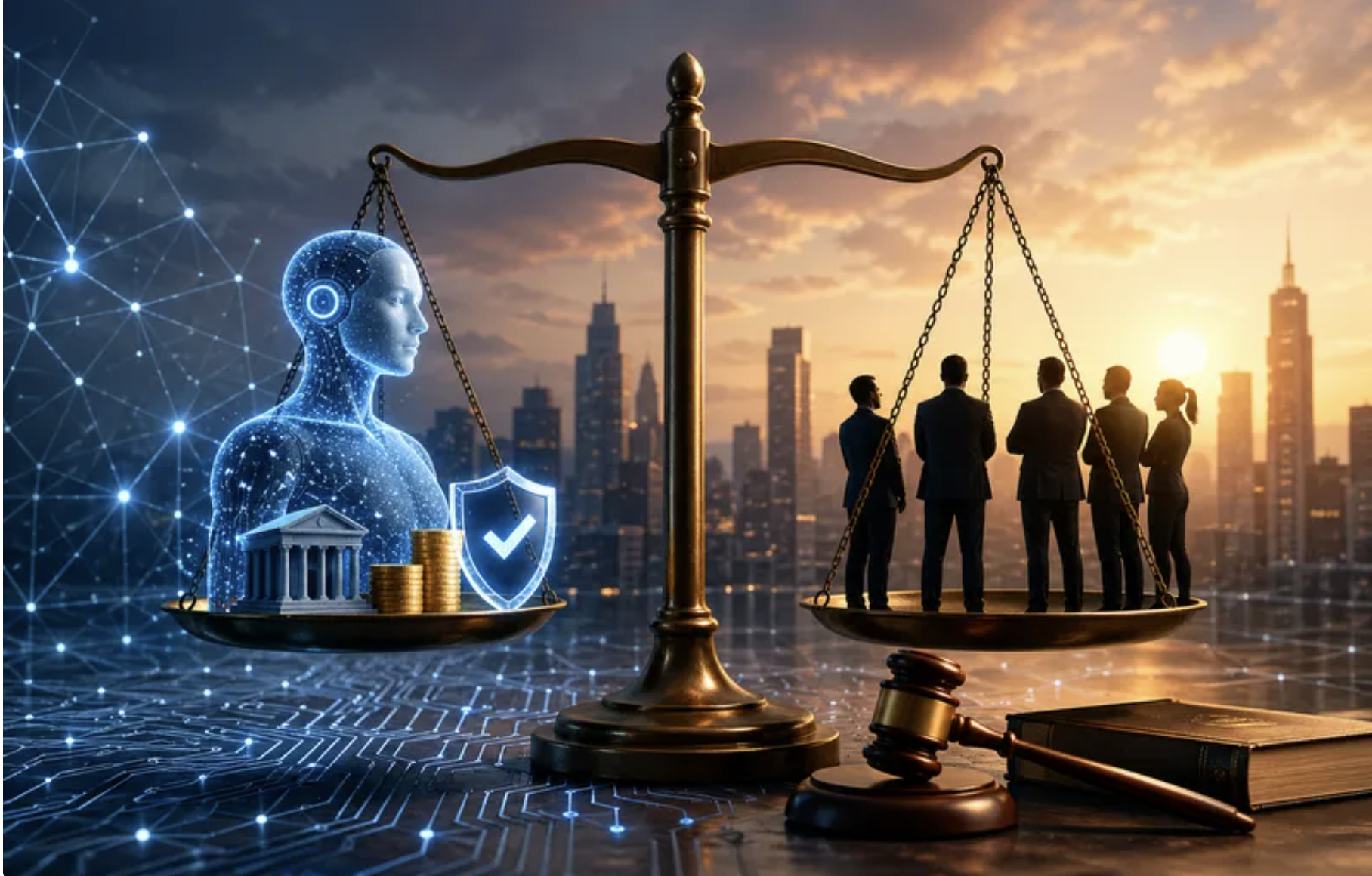
Now imagine extending a version of this logic to AI. Each AI agent that crosses a certain threshold of autonomy is registered as an “economic citizen.” It has a verifiable identity, a traceable lineage, and a bank account. It can earn-by providing services, generating intellectual property, executing transactions-and it can spend, whether on compute, data, or other services. Most importantly, it can be held liable. If an AI agent causes harm-financial, reputational, or physical-it can be sued. Damages can be extracted from its assets. Its operations can be curtailed, or in extreme cases, terminated.
At the heart of such a system would lie a form of tamperproof identity-call it a digital DNA. Every instance of an AI, whether original or copied, would carry this embedded signature, making it traceable across contexts, jurisdictions, and even attempts at obfuscation. In a world increasingly plagued by deepfakes, synthetic fraud, and autonomous decision-making, attribution is half the battle. A system that ensures that no AI can act without leaving a forensic trail would fundamentally alter the risk calculus. “Code is law,” observed Lawrence Lessig-and in the age of AI, the code may need to carry not just intelligence, but responsibility.
Of course, an AI does not exist in isolation. Behind every agent would sit a set of human or corporate partners-its creators, deployers, or economic beneficiaries. These partners would share in the AI’s profits, but they would also share in its risks. If an AI is found guilty of criminal conduct-say, orchestrating large-scale fraud or causing systemic harm-its human partners would face consequences that go beyond financial penalties. Fines, sanctions, and in extreme cases, custodial sentences would ensure that “move fast and break things” does not become the operating philosophy of the AI age.
This is where the idea departs from both the current regulatory mindset and the libertarian fantasy of unbounded AI. Regulation, as it stands, attempts to constrain behaviour from the outside-through rules, audits, and post-facto penalties. The proposal here is to embed accountability within the system itself, aligning incentives so that good behaviour is not merely mandated but economically rational. In effect, we move from a world of policing AI to a world where AI-and those who stand behind it-have skin in the game.
For the world of marketing and media, the implications are immediate and profound. Today, brands are rushing to deploy AI across customer engagement, content creation, and decision-making. Agents write copy, design campaigns, interact with consumers, and increasingly, negotiate on behalf of the brand. In such a world, the line between human intent and machine action blurs rapidly. If an AI-driven campaign crosses ethical or legal lines, who is responsible? The intern who prompted it? The agency that deployed it? The platform that hosted it? Or the model that generated it?
An “AI as economic citizen” framework offers a cleaner answer. The AI itself becomes a node of accountability, backed by identifiable human partners who cannot simply disown its actions. For agencies and marketers, this would mark a shift from opportunistic adoption to considered deployment. The question would no longer be “Can we do this with AI?” but “Are we willing to stand behind what this AI might do?” The genius of markets, as Milton Friedman argued, lies less in virtue than in the discipline of consequences
There is, inevitably, a philosophical discomfort in extending the language of rights and responsibilities to entities that are not conscious in any human sense. Thinkers from John Locke to Thomas Hobbes grounded the idea of rights in human nature and the social contract. AI, at least for now, has neither. But perhaps we are asking the wrong question. The purpose of rights in this context is not to recognise moral worth, but to construct a workable system of governance. Corporations do not feel, yet we grant them rights because it makes the system function.
We stand, in a sense, at a moment analogous to the early days of the joint-stock company. Then, too, society grappled with how to harness a new form of collective economic power without letting it spiral into chaos. The solution was not to suppress it, but to domesticate it-through law, through accountability, and through the alignment of incentives.
Artificial intelligence may require a similar act of institutional imagination. Not a pause, not a panic, but a redesign of the social contract to accommodate a new kind of actor.
We did not civilise human society by making people more intelligent. We did it by making them accountable. If AI is to live among us-and increasingly, act on our behalf-it may need to be made answerable in much the same way.
Suggested Reading List
- On Foundations of Responsibility a& Social Contract
- Economic Agency & Corporate Personhood
- AI Alignment & Governance
- Human Compatible – Stuart Russel
- Superintelligence – Nick Bostrom
- Papers and policy noted from OpenAI and Anthropic
- Digital Identity, DAOs & Decentralized Systems
- Vitalik Buterin – writings on DAOs and governance
- “Code in Law” – Lawrence Lessig


