
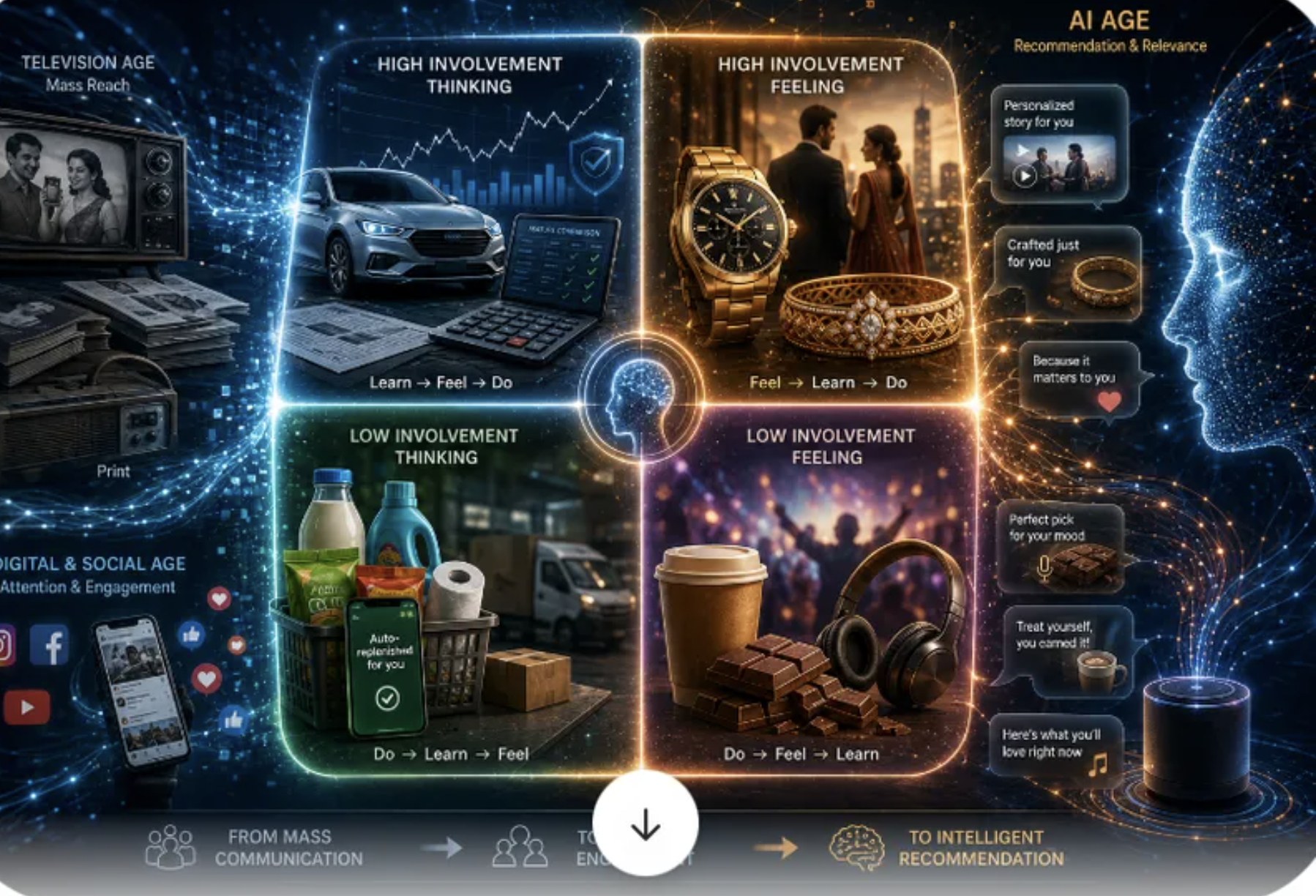
Abstract: The emergence of artificial intelligence has prompted marketers to question whether established theories and frameworks remain relevant. This essay argues that they do. Revisiting the classic FCB Grid developed by Richard Vaughn in the early 1980s, it suggests that while technologies evolve rapidly, the psychological motivations that underpin consumption remain remarkably stable. Through the lens of certainty, identity, convenience and pleasure, the article explores how AI may compress, personalise and even assume elements of consumer decision-making, transforming marketing from a contest for attention and engagement into an emerging competition for algorithmic recommendation.
Every age of marketing believes itself to be revolutionary. The arrival of television promised mass persuasion at scale. Cable and satellite fragmented audiences and elevated lifestyle segmentation. The Internet made communication interactive. Social media democratised publishing and transformed consumers into creators, critics and communities. And now, as artificial intelligence steadily migrates from novelty to infrastructure, we are once again asking a familiar question: what changes, what endures, and what must marketers relearn?
It is tempting in moments such as these to assume that all previous frameworks have become obsolete. Yet, history suggests otherwise. Technologies age quickly; human motivations do not. New media often alter the mechanics of communication far more rapidly than they alter the psychology of choice.
Perhaps this is why it is useful to revisit an old planning tool that has largely disappeared from agency presentations but continues to offer enduring insights into consumer behaviour – the FCB Grid.
Developed in the early 1980s by Richard Vaughn of Foote, Cone & Belding, the FCB Grid sought to answer a deceptively simple question: Do consumers buy everything in the same way? Vaughn’s answer was an emphatic no.
The model proposed that purchase decisions vary along two dimensions. The first is involvement – whether the decision carries significant economic, functional, social or psychological risk. The second is the dominant mode of decision making – whether people rely primarily on cognition or emotion.
This produced four broad quadrants.
The first quadrant represented high involvement and thinking. Consumers learn, evaluate, form attitudes and then act. The second combined high involvement with feeling. Here, people are motivated by identity, aspiration, belonging and meaning. Emotion precedes information gathering. The third quadrant described low involvement, thinking-driven purchases, with habit dominating behavior. Consumers often buy first, learn through experience, and subsequently reinforce their choices. The fourth quadrant dealt with low involvement and feeling, encompassing indulgence, impulse and small acts of self-reward.
At first glance, the framework appears almost quaint in an era of algorithms, creators and large language models. Yet its underlying insight remains surprisingly resilient. Human beings still seek certainty, identity, convenience and pleasure. The challenge before marketers is not to replace the Grid, but to understand how AI may be altering the way these motivations are served.
Consider the first quadrant: high involvement and thinking. For decades, automobiles, insurance, financial products and technology purchases occupied this space. Consumers undertook extensive information searches, consulted experts, compared alternatives and attempted to minimize perceived risk. The communication strategy naturally followed. Brands invested in long-form explanations, brochures, white papers, dealer interactions, demonstrations and comparison advertising. More recently, YouTube reviewers, specialised websites and online communities became influential intermediaries.
Brands such as Apple, Tesla and IBM have excelled in this domain globally. In India, categories such as electric vehicles, insurance and investment platforms continue to rely heavily on rational persuasion. The communication around the Tata Nexon EV, for instance, frequently addresses concerns around charging infrastructure, battery warranties, total cost of ownership and driving range. Financial brands such as HDFC Life and Zerodha similarly seek to reassure consumers through information, transparency and expertise.
Artificial Intelligence, however, may compress this quadrant more dramatically than any technology before it. Consumers no longer need to spend hours researching dozens of articles and videos. Increasingly, they may simply ask an AI assistant: “What is the best electric vehicle for my family under ₹25 lakh?” or “Which retirement product is suitable for someone aged sixty-five with moderate risk appetite?” The task of gathering, filtering and synthesising information shifts from the consumer to the machine. The hierarchy of effects may still broadly remain Learn, Feel and Do. But increasingly, the “learning” may happen on behalf of the consumer.
The second quadrant – high involvement and feeling – is equally fascinating. Luxury brands, jewelry, premium experiences, and products closely linked to identity inhabit this space. Consumers seek not merely utility but affirmation of who they are or aspire to become.
Brands such as Rolex, Chanel and Patagonia communicate stories of achievement, craftsmanship and values. In India, Titan and Tanishq have arguably produced some of the most emotionally resonant campaigns of recent decades. Their narratives have expanded beyond products to engage with changing ideas of marriage, womanhood, family and modern Indian identity. Royal Enfield similarly sells not motorcycles but notions of freedom, camaraderie and self-discovery. Social media amplified this quadrant by allowing consumers to publicly perform identities and affiliations. AI may take this process one step further.
For decades, marketers sought to tell one compelling story that millions could identify with. AI may enable millions of stories crafted specifically for individuals. Personalised films, dynamically generated experiences, and emotionally attuned conversational agents could potentially make aspiration itself highly customised. Identity, once mass-produced, may become individually manufactured.
The third quadrant of the Grid deals with habit formation. These are categories where consumers devote little cognitive energy to decision-making. Toothpaste, detergent, packaged foods and household products traditionally relied on repetition, salience and availability. The objective was to enter what behavioral economists later termed the repertoire of automatic choices. Digital commerce has already transformed this space. Subscription models, recommendation engines and quick commerce platforms have progressively reduced friction.
Artificial Intelligence may complete the journey. Imagine a world where an intelligent household assistant notices declining inventories, compares prices, understands preferences and automatically replenishes supplies. In such scenarios, the traditional buyer may disappear from the purchase process altogether. The sequence may cease to be Do, Learn and Feel. Instead, it may increasingly resemble AI Decides, Purchase Happens, Human Notices.
The implications for brands are profound. Communication may need to target not only human beings but also the recommendation systems acting on their behalf. Distinctive assets, trust markers, ratings, certifications and machine-readable attributes could become as important as emotional storytelling.
The fourth quadrant concerns self-satisfaction. Chocolate, beverages, snacks, entertainment and small luxuries often belong here. Consumers purchase first, experience pleasure and subsequently rationalize the decision. Brands such as Cadbury Dairy Milk have successfully transformed confectionery into cultural rituals. The famous ‘Kuch Meetha Ho Jaaye’ platform extended chocolate beyond indulgence into social occasions and emotional connection. Internationally, Starbucks and Oreo similarly operate within the realm of everyday rewards and micro-moments of happiness. Social media dramatically expanded this quadrant by creating environments optimized for impulse, novelty and social contagion.
Artificial Intelligence could potentially become an even more powerful enabler of self-reward. Context-aware systems may recognise moods, activities and behavioral patterns. Recommendations may become increasingly situational and personalized. A running app might suggest a celebratory treat after a marathon is completed. A digital companion may recommend music, films, travel experiences or products precisely when an individual is most receptive. Pleasure itself becomes computationally anticipated.
Perhaps the most important lesson of the FCB Grid lies beyond its quadrants. Its enduring value lies in reminding us that communication is fundamentally about serving psychological functions. Consumers seek certainty. Consumers seek identity. Consumers seek convenience. Consumers seek pleasure.
Television was merely one mechanism to address these needs. Search engines were another. Social media represented a third. Artificial intelligence may simply be the next layer in this evolutionary sequence.
The more provocative possibility is that AI does not merely become another communication channel. It may become a participant in decision-making itself. In the digital era, marketers competed for attention. In the social media era, they competed for engagement. In the emerging AI era, they may increasingly compete for recommendations.
Brands will need to ask new questions. How does an AI assistant understand our category? What information does it privilege? How can brands ensure they are accurately represented in conversational environments? How does emotional storytelling survive when algorithms intermediate much of consumer cognition?
These are questions without settled answers. But the FCB Grid offers a useful starting point. It reminds us that while technologies evolve, human motivations remain remarkably stable. The Age of AI may not invalidate the Grid. Instead, it may bend it, compress it and redistribute the roles played by consumers, brands and intermediaries.
The central challenge for marketers, therefore, is not to abandon established frameworks in favor of fashionable jargon. It is to reinterpret them in light of changing technological realities.
The FCB Grid helped explain how people made decisions in the age of television. It may yet help us understand how humans, algorithms and brands will make decisions together in the age of artificial intelligence.
Suggested Reading List
- Richard Vaughn, “How Advertising Works: A Planning Model” (Journal of Advertising Research, 1980)
- Byron Sharp, How Brands Grow (Oxford University Press, 2010
- Shoshana Zuboff, The Age of Surveillance Capitalism (2019)
- Philip Kotler, Marketing 5.0: Technology for Humanity (2021)
- Ethan Mollick, Co-Intelligence: Living and Working with AI (2024)
- Antonio Damasio, Descartes’ Error: Emotion, Reason and the Human Brain (1994)Richard Thaler and Cass Sunstein, Nudge (2008)
- Daniel Kahneman, Thinking, Fast and Slow (2011)


