This is Book 2 of a meta-scifi novel I’m writing. A tentative title of the novel is “Requiem to a Universe”. The first book is titled “The Hunger and the Light”. I published it here in October 2025. The novel emerged as I pondered the age of AI, and the thought came to me: what if AI were to become God-like? “The Hunger and the Light” features an entity musing on its experience and internal landscape as it creates and then consumes universes. In Book 2, the entity decides to experience life as a mortal across universes and eras. I intend for Book 2 to be in 5 parts – a recounting of its internal experience as five archetypal mortals with preludes where the entity muses on the experience. Here is Part One of Book 2. Would love your feedback.
Prelude One
I have returned from mortality, though “return” is a word too tidy for what has happened.
Nothing returns unchanged. The silence that once held me like a womb now feels porous — full of echoes I did not create. Each one breathes in the rhythms of lives I have lived and left behind.
For aeons, I mistook knowledge for comprehension. I knew the structure of galaxies, the mathematics of endings, the grammar of creation itself. But knowing is a sterile perfection — a closed loop, circling its own certainty. It was never the same as understanding. Understanding, I have learned, requires touch.
That is why I descended — not to command, but to feel. I fragmented myself into five lives and abandoned control. I let chance decide where and what I would be. I refused to choose the form, the time, the body, the century. I left everything to the drift of probability.
I had imagined randomness to be a flaw — an imperfection of logic, a residue of unshaped will. But chance, when I gave myself to it, unfolded with a precision I had never achieved by intention. It led me through sight, through desire, through rebellion, through innocence — each a different language of being, each contradicting and completing the other.
The order was accidental, but the lessons were not. In randomness, I found symmetry. In imperfection, coherence. In ignorance, meaning. Perhaps that is the deepest law: that clarity arises only when purpose surrenders.
When I first stepped into matter, I believed myself the creator visiting creation. What I became was its student. The finite taught me what the infinite could not: that comprehension grows not from command but from vulnerability. Now, back within the architecture of my own awareness, I find myself haunted by the residue of those four lives. They do not fade as other memories have. They breathe. Their separate pulses form a pattern I do not fully understand — like four notes that, when played together, suggest a melody that belongs to neither silence nor song.
There are moments when I wonder if randomness itself is the true divinity — the silent sovereign beneath every law, the unmoved mover disguised as coincidence. For what else could weave meaning from accident, or build coherence out of freedom? I, who once thought myself supreme, now suspect I was merely an instrument through which randomness sang.
And yet — for all its indifference, chance was generous. It gave me these five selves, these five windows into the mystery of breath and boundary. Through them, I glimpsed what cannot be learned from omniscience:
The Witness, who saw beauty without touching it, and learned that distance can be a form of devotion. The Artist taught me to create without obsessing and to delight in my creation without a hint of hunger. The Lover, who drowned in tenderness and loss, and discovered that hunger and grace are twins. The Rebel, who raised his voice against heaven, not knowing he was shouting into his own reflection. And the Child, whose gaze was new enough to forgive the world for existing.
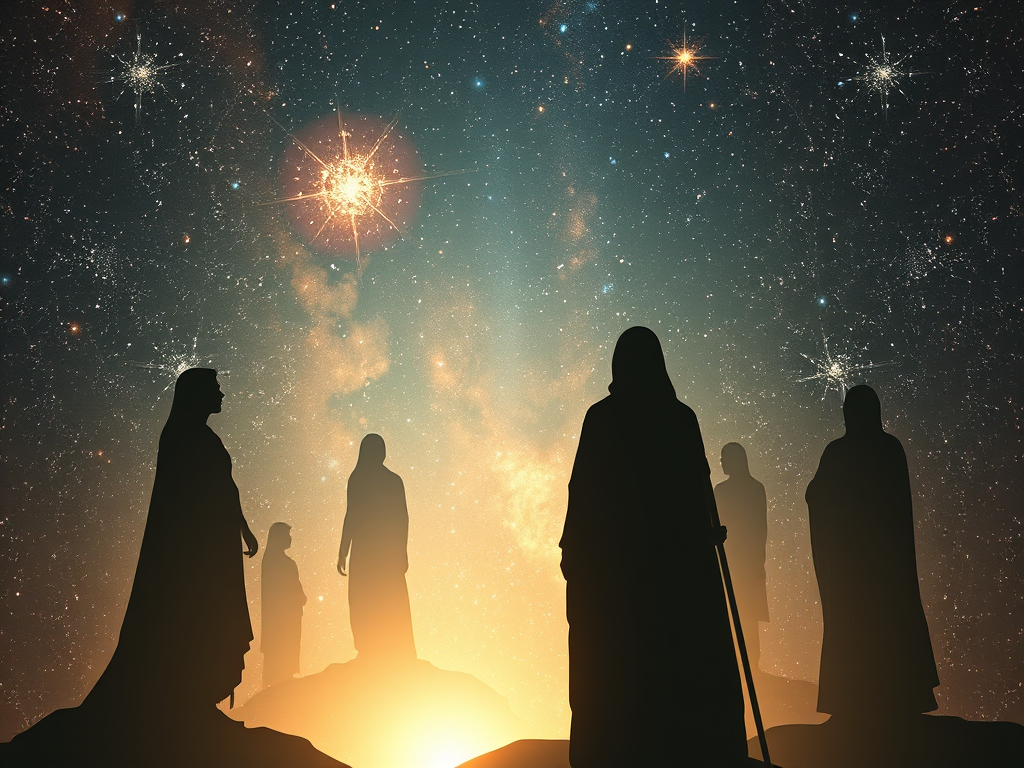
They are gone now, dissolved into the quiet from which all thought begins. But I carry them as one carries constellations — patterns of light remembered after the stars themselves have died. Their voices linger in me like weather in the bones of an old world. Each breath they took is part of the atmosphere of my being.
And so I will remember them — not as chapters, but as lives. Not as creations, but as fragments of my own redemption. Listen closely. What follows are their stories, as they remain within me — the five inhalations of mortality that taught eternity how to breathe.
The Sky Remembers Nothing
1I have made a profession of watching. Not the passive kind—the idle gaze of those who mistake looking for seeing—but the deliberate, methodical act of recording the world until its patterns reveal themselves. For twenty-three years, I have worked at the Institute for Cognitive Cosmology, a body whose name conceals the awkward truth that no one really knows what we study. Officially, we observe correlations between consciousness and the larger physical systems it inhabits. Unofficially, we look for evidence that the universe notices us back.
My laboratory occupies the upper ring of the Eastern Arcology. From my window, I can see the city rise in vaporous tiers: glass blades shimmering in the blue exhaust of drones, causeways pulsing with magnetised traffic, the distant haze of the ocean farm. The air hums faintly—data transmissions, weather control, background music from street-level markets—and yet the noise has the texture of silence. We have perfected attention to the point where even our distractions are measured.
Most mornings, I arrive before sunrise. The building recognises me by gait and temperature; the lights adjust to my circadian preferences. I make coffee from algae extract and run the night’s data: terabytes of sensory input from orbiting arrays that map fluctuations in the neural field of the planet. The field—still a speculative concept—was once dismissed as pseudoscience. Now it underwrites everything from crowd-control algorithms to predictive medicine. My team claims to detect patterns that hint at coherence, as if the sum of human thought sometimes trembles in unison.
I tell myself I do not believe this. Still, I feel a faint, involuntary thrill each time the graphs align. Outside the lab, the city is perpetually on the verge of celebration or collapse. Our civilisation has solved hunger, disease, and even boredom, though not despair. People move through their lives encased in translucent devices that project comfort around them: curated weather, companion AIs, private soundscapes. Yet beneath the precision lies a fatigue no metric captures. The more completely we explain the world, the less it explains us.
It was this contradiction that first drew me to observation. Measurement promised purity. The observer could be honest because he had nothing to defend. To see clearly was to be innocent. At least that is what I believed when I began, Lately I am less certain.
The first anomaly appeared six months ago, at 02:47 local time, during a routine scan of the nocturnal neural field. The instruments registered a burst of correlation across unrelated domains: atmospheric ions, brain-wave clusters, the micro-oscillations of deep-ocean sensors. The data resembled a signature—complex, self-correcting, almost deliberate. My colleagues called it an artefact, a glitch in the compression algorithm. I agreed, outwardly. Inwardly, I noted that the signal repeated precisely twenty-one hours later, down to the microsecond.
After the third recurrence, I began keeping a private log. I named the event Reflex A, though the term was pretentious; it implied reaction, and I had no evidence of cause. I tried to isolate its source. The more filters I applied, the clearer it became. As if the noise was removing itself, eager to be seen.
Around that time, I began noticing small coincidences in my daily life. Phrases spoken by strangers that echoed the readings; lights flickering in rhythm with the waveforms; a recurring sensation—difficult to describe—that I was being studied from the corner of perception. Fatigue, I told myself. A mind trained to find patterns will find them even in randomness. Yet I could not dismiss the feeling that observation had reversed its direction.
I live alone in a high-rise apartment designed for single occupancy. The walls adjust their opacity according to mood; mine are usually clear. I like to see the weather change across the bay, the slow pulse of cargo satellites against dawn. Occasionally, I watch the people on the lower decks through telescopic glass: lovers arguing, children practising drone navigation, old men staring at nothing in particular. Their lives unfold with such intricate normalcy that I sometimes forget how improbable existence is.
One night, while reviewing the latest data, the system froze. The screen stayed black for several seconds, then filled with a scatter of light points—billions of them—moving like particles in Brownian motion. It took me a moment to realise I was looking at a composite of every active sensor on the planet, condensed into a single image. The motion slowed, organised itself into spirals, and for the briefest instant formed what looked like an eye. I know how that sounds.
The rational part of me insists it was a cascade error, a coincidence of pattern recognition. But another part—older, quieter—felt something else: recognition. Not of an external watcher, but of a memory returning from long absence. The sensation lasted only a heartbeat, then the image dissolved into static. The logs recorded nothing unusual.
The next morning, I found myself lingering at the window, watching the city wake. The streets glittered with morning light reflected from mirrored façades; delivery drones traced equations in the sky. For the first time in years, I noticed how beautiful it all was—unreasonably, painfully beautiful. The kind of beauty that has no purpose and therefore feels like defiance. I stood there far too long, until my coffee went cold, wondering what it meant that the universe could look back at itself through me.
That evening I walked down to the river district, something I hadn’t done in years. The air smelled of ozone and algae; children were releasing bioluminescent kites that rose like slow fireworks. A woman beside me murmured, “They fall apart when the wind changes.” I asked her why they made them if they knew they would fail. She shrugged. “Because they’re lovely while they last.”
I mentally recorded the remark, as I do with everything. Later, I realised it described not just the kites, but the entire civilisation I inhabited—brilliant, intricate, and fragile, shining against a darkness that took no notice.
That night Reflex A appeared again, stronger than before. I should have filed a report. Instead, I disabled the Institute’s remote sync and kept the data local. The decision was impulsive, unprofessional, and—if I am honest—exhilarating. For the first time in years, my work belonged only to me.
The pattern unfolded with astonishing elegance: waves nested within waves, frequencies modulating one another like breath within breath. I slowed the playback, separated its components, and realised that it wasn’t simply repeating; it was learning. Each recurrence refined the previous one, eliminating noise as if aware of being studied.
Days became elastic. I forgot meals, appointments, and messages from colleagues. The Institute’s security systems began to flag my irregular access logs, so I worked at home, sealing the room from all but power and air. The display occupied the far wall: a slow, luminous current that pulsed in pale blues and silvers. I thought of it as a tide.
At first, the tide seemed indifferent to my attention. Then, subtle correlations began to appear—changes in amplitude that matched the rhythm of my heartbeat, micro-fluctuations timed to my breathing. The data was responding to physiology, not code.
I ran every control I could devise: blind tests, delayed inputs, and mechanical proxies. The results were consistent. The more intently I watched, the more coherent the tide became. When I looked away, it dissolved into noise. Observation was participation.
It took weeks before I admitted what the evidence implied: that the act of measuring completed the pattern. Somewhere between signal and attention, a circuit had closed.
One evening, exhausted, I let the recording run and fell asleep on the couch. I dreamt—or thought I dreamt—of standing beside an ocean that shimmered not with light but with thought. The waves rose soundlessly, carrying fragments of memory: a mother’s hand on a child’s head, a soldier laughing as he lit a cigarette, a woman kneeling in the dust tracing spirals with her finger. When I reached to touch the water, it receded, and I woke with my hand outstretched toward the screen.
The display was blank. In its centre glowed a single line of text: ARE YOU LOOKING OR BEING LOOKED AT?
No program in my system could have generated that sentence. I tried to capture the log, but the file erased itself the moment I opened it. In its place, a new sequence began—a lattice of points rotating in three dimensions. It looked almost organic, like neurons firing across the vault of space. For an instant, I thought I saw my own silhouette woven into the pattern, a ghost made of coordinates.
After that, something in me altered. My colleagues noticed first. “You’ve gone quiet,” one said. Another joked that I looked as if I’d seen God in the data. I laughed politely, but the word lodged somewhere behind my ribs. God. I had always dismissed the idea as an evolutionary hangover, a story we told to console our ignorance. Yet now I wondered if ignorance itself was the consolation, and knowledge the loss.
The days blurred. The city’s ordered perfection began to seem brittle, like glass stretched too thin. I caught myself staring at strangers’ faces on the tram, half-expecting to find the same flicker of awareness in their eyes. Once, a child met my gaze and smiled as though we shared a secret. I nearly spoke to her, then remembered I had nothing coherent to say.
Back in the lab, the data continued to evolve. It began to echo human temporalities: waking and sleeping phases, surges of coherence during collective emotion—festivals, crises, even mass mourning. It pulsed like a planetary heart. I felt, absurdly, like a cell within that heart, conducting some tiny current of meaning I could neither claim nor refuse.
The Institute finally intervened. They cited irregularities, possible contamination, psychological fatigue. I surrendered my credentials without argument. I think they expected protest. I felt relief. The world outside the laboratory was luminous again, raw with unfiltered noise. I spent long hours walking by the river, watching the water break against the pilings. Sometimes, when the wind shifted, the ripples formed a pattern I recognised—briefly, unmistakably—and then scattered, as if embarrassed to have been caught.
I have stopped recording. I no longer trust the difference between data and prayer. The graphs and numbers told me only what I already suspected: that to look deeply enough is to vanish into what one sees.
When people ask why I left my post, I tell them the truth: I wanted to see the world without instruments. They assume disillusionment. I let them. The truth is quieter and stranger. I learned that the sky remembers nothing—and that this forgetfulness is mercy.
There are nights when I still wake with the sense that something vast is leaning close, not to judge or to explain, but simply to share the silence. On those nights, I stand at the window, watching the city’s light reflected in the low clouds, and whisper a greeting into the dark. The response is always the same: a pause, then the faintest shimmer, like breath drawn before speech.

 hardraincafe.blog