
The two dimensions of cognitive and emotional appeal are part of the brand-building matrix and toolkit of every marketing and advertising person on earth.
The crafting of the cognitive dimension of a brand’s appeal is dictated mostly by logic – the configuring and communication of product features to the functionality that the consumer seeks from the category.
The crafting of the emotional dimension of a brand’s appeal, on the other hand, is considered to be more of an art form than a science. It is this aspect that allows people in the advertising business label themselves as “creatives” and for some others to label advertising itself as a dark art.
In an increasingly competitive world marketers are beginning to realise that building an emotional connect with consumers needs to become a core part of marketing strategy and not just a function of the “creative” element of marketing communication.
As a result efforts are now underway to pursue the forging of emotional connections as a science and a strategy.
In fact building emotional connects with consumers is beginning to be part of a broader business strategy involving the entire value chain – from product development and marketing to sales and service
Scott Magids, Lan Zorfas and Daniel Leeman of Motista, a US-based consumer intelligence firm has done some interesting work with the objective of developing “a standard lexicon of emotions” a lexicon that brands can use to define emotional connect and link it to results.
The motivators driving emotional connect are varied. Magids, Zarfas and Matista uncovered over 300 across tens of categories and hundred of brands in the US. They also discovered that establishing an emotional connection took the brand along a “predictable ‘emotional connection pathway’ – 1) being unconnected to 2) being highly satisfied to 3) perceiving brand differentiation to 4) being fully connected” On the emotional connection pathway the customer becomes more valuable to the brand over each of the four steps of the pathway.
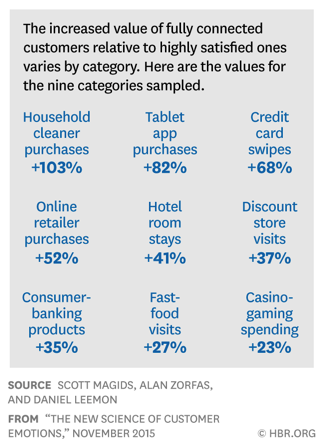
Magids et al found that depending on the category a customer can become, on the average, 52% more valuable to a brand as reflected in a variety of metrics, such as purchases and frequency of use.
The figure below lists the value addition estimates they arrived at for some specific categories.
So how does one get a brand to move higher on the “emotional connection pathway”?
Emotional motivators differ across product categories as also where a customer is on his customer journey vis-a-vis the category and the brand.
In terms of generalities Magids found that social media has a big impact on emotional connection. They found that one condiments brand found that 60% of its social-network-affliated customers (especially followers on Twitter, Facebook and Pinterest) – versus 21% of all customers – were emotionally connected.
My experience with social media marketing in India has been that the pay-off might not be currently as strong in india as it is in say, the US.
However with ongoing mobile Internet revolution and the regional languages push within the social media universe in India, that might change over the coming years.
The process that Magids et al recommend to develop an effective emotional connection strategy is to apply big data analytics to detailed customer data sets to identify the emotional motivators for a category’s most valuable customers. The next step would be to quantify the current and potential value of motivators for a given brand. This would then form the basis of identifying strategies to leverage emotional motivators.
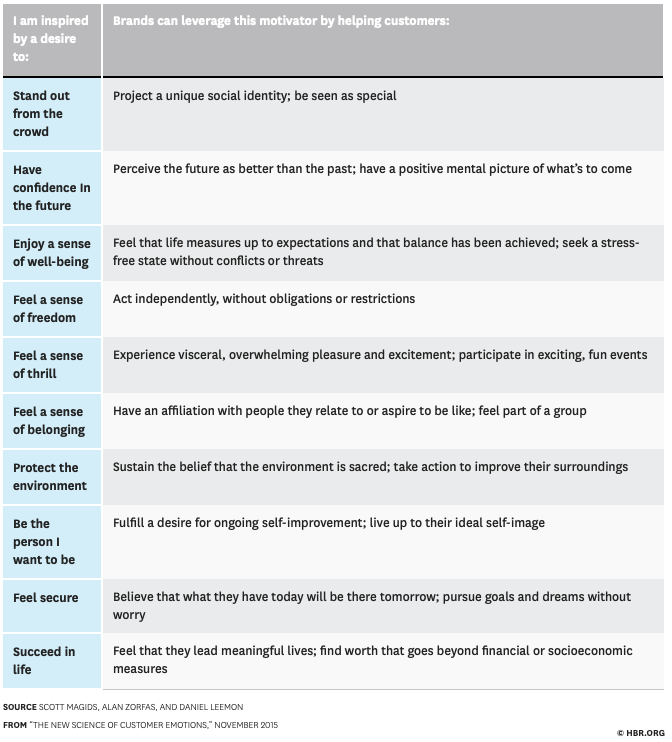
To conclude, Magids et al list a set of emotional motivators that are universal in the sense that a sub-set of this list would be applicable to most categories and brands. I reproduce this list below. Perhaps to some extent the list would be “universal” in the same way in India too.
A good starting point perhaps to develop “a standard lexicon of emotions” for categories and brands in India.

 hardraincafe.blog
Well researched – the conclusions are spot on
LikeLike