

In my business of crafting and advocating marketing, brand and marketing communication strategies, imagination is an asset. Different from providing accounting services, creative accounting services can be a profitable albeit unsavoury and risky line of business.
To keep the faculty of imagination nimble, it pays, now and then, to crane its neck and take a peek into the future, not into the distant future but into a possibility that one, with some luck, can live to see.
The rising power and ubiquity of computing combined with the increasing channelling of the desiderata of life through digital means of communication has already resulted in profound ongoing shifts in marketing discipline: e-commerce, Big Data and adtech.
And even while marketers adapt to the changes, another tsunami of change could be building up.
It is now common consensus that Artificial Intelligence will change human lives and society at a depth that is an order of magnitude more intense than the level at which IT or the Internet did.
Most marketing pundits have analysed the effects of the AI revolution in terms of how AI is to be used in the service of marketing – AI as a tool in the hands of marketing—multiplying the omniscience of marketing and brands just as e-commerce, big data and ad-tech have done.
But what if that is just hubris? Many thinkers worry about AI reaching a singularity stage where it overpowers humanity. Much before that, what if AI develops into a mini-singularity that changes the very nature of the marketplace and completely transforms the very foundations of marketing?
Interesting thought.
Neeraj Dawar and Dr Neil Bendle, in their article titled “Marketing In The Age of Alexa” in the May-June 2018 issue of HBR, envisage such a scenario.
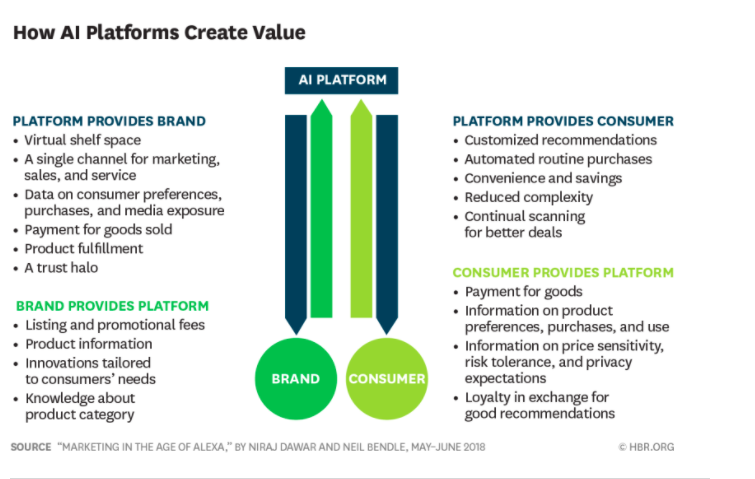
Dawar and Bendle foretell a scenario wherein AI assistants like Alexa and Siri have metastasised into all-encompassing platforms that intermediate all the buying of products and services by an individual. They anticipate needs, discern wants, track and analyse offerings and order products and services to minimise costs and maximise satisfaction, changing many of the critical dynamics that currently form the bedrock of marketing. For example, as all FMCG marketers know, brand loyalty in the frequently bought consumer goods category is primarily a function of inertia. Consumers lack the time and inclination to evaluate options and, therefore, plump for the same brand and variant they bought last time. Now imagine a situation where it is Alexa who does the shopping – she has all the information about all the new products in the market and all the individual’s preferences. And she has all the milliseconds needed to analyse it all!
In such a future, businesses will need to market products and services not to consumers but to the AI platforms that consumers subscribe to. A scenario where the only brands that matter are the Alexas and the Siris of the world. And the only marketing that goes direct to consumers is by the Alexas and Siris of the world. All other businesses will market to the Alexas and the Siris. B2AI marketing?
In such a world, the terms black market and guerrilla marketing will have different meanings. Imagine shadow brands hawking their products directly to consumers away from the all-seeing eyes of the AI platforms.
Dewar and Bendle’s article explores the many facets of this new paradigm. The chart below sums up some of the implications.
 I am
I am
I know that many hard-boiled practitioners will dismiss the above scenario-building as blue sky thinking of little practical value today. A line of reasoning similar to the one used by the decision-makers at Nokia in ignoring an upstart like the iPhone and the outlandish concept of Apps.
Then again, this issue might be relevant for marketers in developed countries like the USA, but in India, one needs to concentrate on bread-and-butter issues. True. But then India is many markets rolled into one. There are 9 to 10 million households (projected to go up to around 15 million by 2025 – that is 65 million individuals, given India’s average household size) who are affluent and sophisticated consumers, at par with the affluent consumers in the developed world. Plus, India has leapfrogged from a landline-scarce society to a smartphone society in the space of a generation. It would be within the realm of possibilities that it could leapfrog into an AI-driven league by the time the 300-million-strong Generation X in India matures.

 hardraincafe.blog
5 Comments